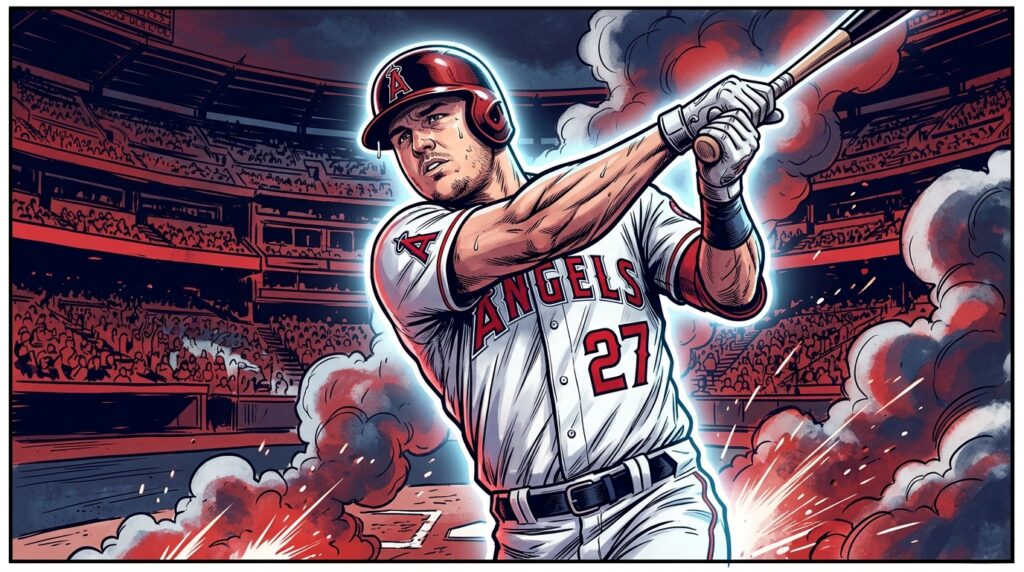
Mike Trout is slashing .239/.400/.534 with a 171 wRC+ through the first few weeks of 2026, and the most common response from outside Anaheim has been some variation of “sure, but let’s see how long it lasts.” That response was earned — years of false starts and torn menisci and back surgeries will do that. But at some point, the collapse narrative stops being cautious analysis and starts being intellectual laziness dressed up as hard-won wisdom.
The Angels are 12-14, sitting third in the AL West and 1.5 games back of the division lead. This is not a pennant race column. This is a column about paying attention.
Start with what Trout is actually doing at the plate, because the raw numbers undersell it. His whiff rate has dropped to 19.9%, the biggest improvement among qualified hitters in baseball — a significant mechanical shift tied to re-introducing a step-back approach he’d abandoned. His barrel rate sits in the 100th percentile. His sprint speed is 28.6 feet per second, up from 27.9 last year after he dropped five to seven pounds in the offseason specifically for agility. These aren’t the numbers of a guy riding a hot streak; they’re the profile of a hitter who changed something structural and is seeing the results.
The five-homer series at Yankee Stadium made the point more dramatically. Trout became the first visiting player ever to homer in all four games of a series at that park — a feat that generated the kind of attention Angels fans haven’t had to share with the rest of the sport in years. The Angels account posted it, and it landed exactly how you’d expect:
🚨 MIKE TROUT. THREE DAYS STRAIGHT. 🚨 pic.twitter.com/0Kn4lAjIQA
— Los Angeles Angels (@Angels) April 16, 2026
Yeah, yeah. He’s started fast before. Eight home runs in his first 20 games in both 2024 and 2025, and we all know how those ended. The injury history is real and the scar tissue is justified. Acknowledge it and move on.
Here’s what’s different enough to matter: the supporting cast is actually producing. Oswald Peraza is hitting .294 with an .889 OPS — a number that would look good from your cleanup hitter, let alone a guy nobody had circled in March. Zach Neto has five home runs from the leadoff spot and is posting a career-high walk rate, which is exactly the kind of development that changes a lineup’s ceiling rather than just its floor. Jorge Soler has 19 RBI and is doing what veteran acquisitions are supposed to do but rarely actually do. The Angels have scored 126 runs on the season, good for seventh in MLB at 4.85 per game. The offense is legitimate whether Trout is healthy or not, and right now he is very much healthy — he took a 94 mph fastball off the hand in April, missed one game, came back and hit a single while posting exit velocities above 100 mph. Cleared.
Trout has described the shift as less mechanical and more attitudinal: after a last-place 2025 finish, he went into this offseason focused on simplifying his approach and, in his words, just going out there and having fun again. That can sound like cliche filler, but it tracks against the whiff rate drop and the barrel rate spike. Something genuinely changed.
His extra-base hit total of 796 recently drew level with Garret Anderson on the all-time Angels list — which is franchise trivia until you remember that accumulating milestones requires showing up, and Trout is still very much here.
A 12-14 team with the seventh-best offense in baseball, a legitimate lineup top-to-bottom, and the best player in franchise history posting a 171 wRC+ deserves something more than dismissive wait-and-see. The pitching is not a strength, the division has real competition, and Trout’s body has betrayed him enough times that no one owes him unconditional optimism. Watch for the next month and make a real judgment. Either way, the lazy version of Angels skepticism has stopped doing any analytical work.