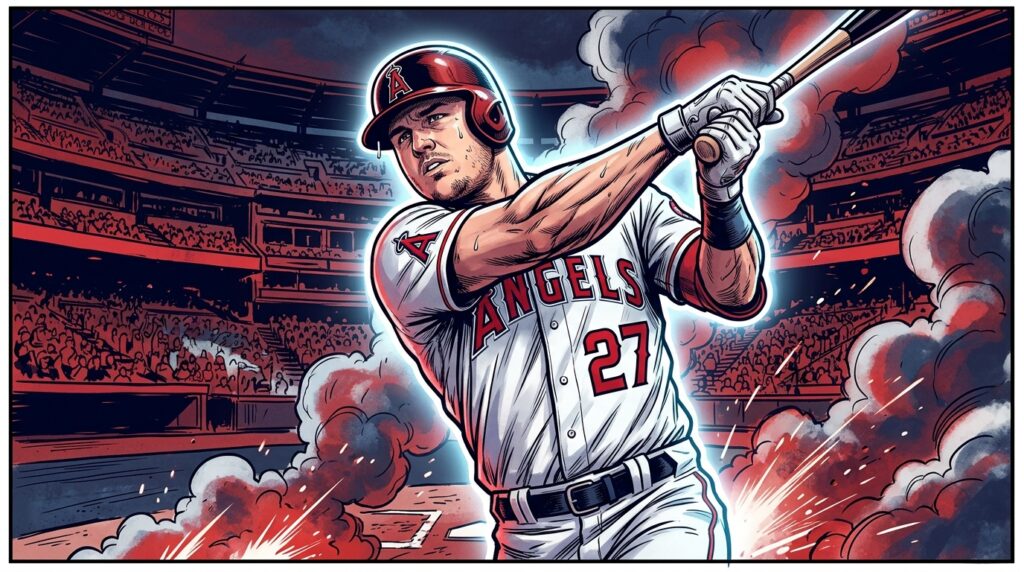
A week ago, we argued on this site that the Angels’ early-season surge was real and that the skeptics were jumping the gun. The Angels were hitting. Trout was healthy. Maybe this year was different. We were wrong — not about Trout, but about what Trout being healthy actually means for this franchise.
Mike Trout is genuinely raking. Through 31 games, he’s hitting .248 with 10 home runs, 20 RBI, and an OPS hovering around 1.000. His walk rate is at 20.2% — a career-high pace — and his strikeout rate has dropped to 20.2%, the lowest it’s been since 2017. A 25.6% barrel rate. This is not a mirage. This is Mike Trout, fully operational, doing what Mike Trout does.
The Angels are 12-20.
That’s the whole article, really. But let’s stay with it a moment longer, because the gap between those two facts — one of the best offensive stretches of Trout’s career happening inside a 12-20 season — is not an accident or a bad-luck streak. It’s organizational policy.
The Angels stripped their payroll down to $153 million this offseason. Trout’s contract carries a $35.5 million AAV luxury-tax hit — roughly 23% of the entire payroll, for one player, on a team that went 72-90 last year. Perry Minasian’s two marquee additions to fix the roster? Grayson Rodriguez and Kirby Yates. Both are already injured. Sam Blum at The Athletic asked pointedly whether Minasian even views 2026 as a contention window. Read between those lines.
As Jeff Fletcher noted after the offense sputtered inside yet another Angels loss:
It was a painful loss for the Angels but a wildly entertaining game for everyone else.
Also, Mike Trout’s “slump” seems over. His OPS has gone from .693 to .883 in the last 3 games. https://t.co/GSBTqxxJcf
— Jeff Fletcher (@JeffFletcherOCR) April 14, 2026
That beat-writer resignation — the exhausted, this-again tone — is the appropriate register for discussing this team. Not outrage anymore. Outrage implies surprise.
FanGraphs documented that the 2025 Angels had the worst team defense ever recorded: -54 OAA. Not worst in the AL. Not worst this decade. Ever recorded. The front office watched that happen and responded with a payroll cut and two free agents who broke before April was over. Zach Neto, to his credit, now profiles as the team’s best player by WAR projections — and that tells you everything about the trajectory here. The kid they drafted is outrunning the generational talent they signed to a lifetime deal.
The Ernie Banks comparison gets made every few years and it’s always a little too neat, but it’s getting harder to dismiss. Banks won two MVP awards, hit 512 home runs, played his entire career with the Cubs, and never appeared in a postseason game. The baseball world loved him for his loyalty. The Cubs organization was never really held accountable for surrounding him with teams that couldn’t win. Trout said in February 2024 that he wouldn’t take “the easy way out” regarding his no-trade clause. He meant it as a statement of character. What it actually means, in practice, is that the Angels get to keep benefiting from his presence — the ticket sales, the All-Star votes, the brand — without ever paying the reputational price of trading him away.
Jeff Fletcher has covered this team long enough to know that Trout’s injury history makes every healthy stretch feel borrowed. That context makes what’s happening now even stranger: the health is real this time, the production is real, and the team is still losing by the same margin they always lose by.
The question nobody in the Angels front office wants to answer is the one that actually matters — not “Is Trout healthy?” but “Healthy for what?” He’s 34. The contract runs through 2030. The Angels have no clear competitive window. Their rotation runs through José Soriano and hope. There is no cavalry coming.
Trout being healthy in 2026 isn’t a redemption arc. It’s a cleaner view of the problem.